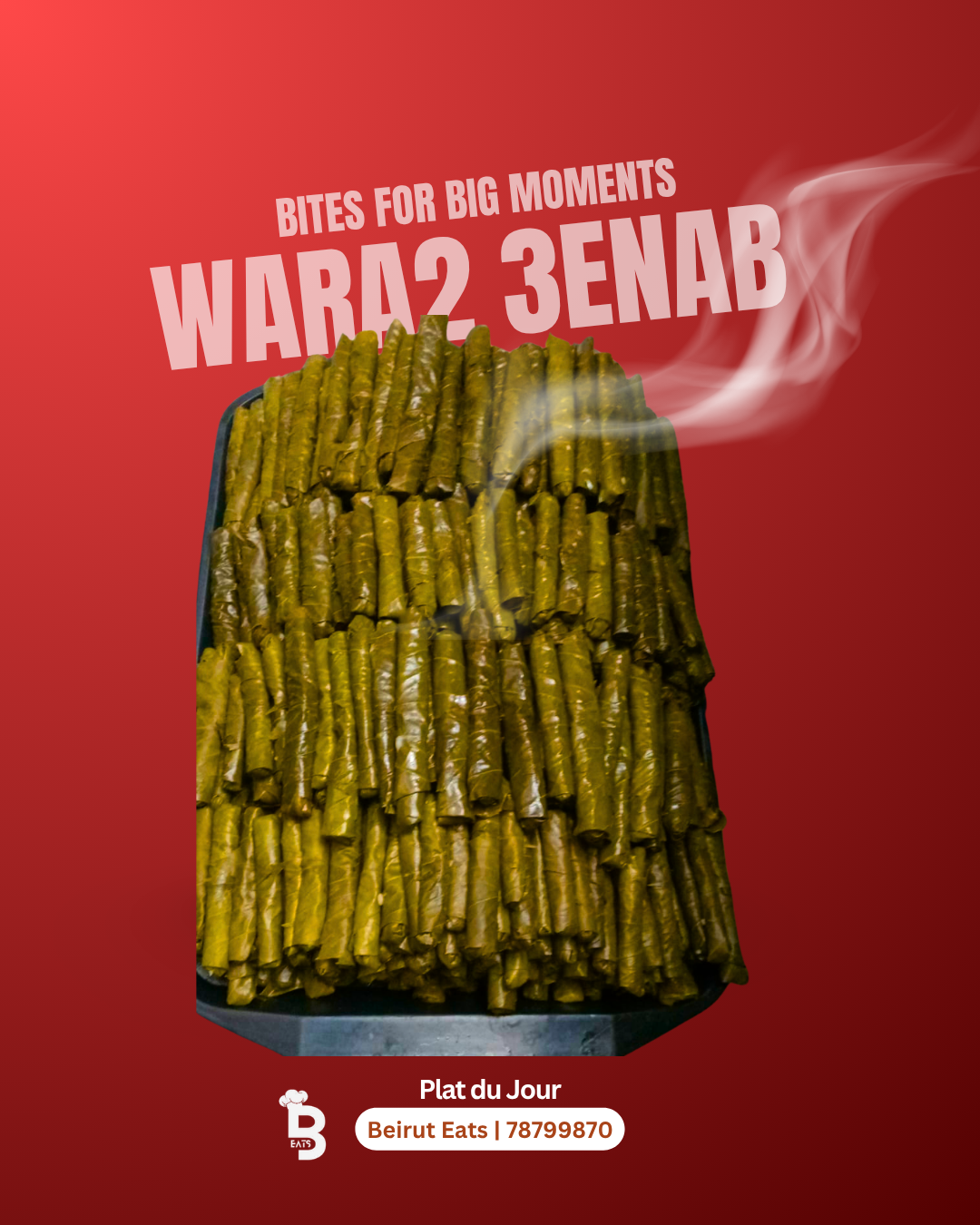
Wara’ enab bi zeit (ورق عنب بالزيت) is the Lebanese vegetarian version of stuffed grape leaves: tender vine leaves wrapped around rice, tomatoes, onion and parsley, then slowly cooked with lemon juice and olive oil. The result should be soft but intact, distinctly lemony and rich with olive oil, with rice that is fully cooked without turning the filling into a paste.
It is one of two important ways Lebanese families prepare stuffed grape leaves. Wara’ enab can also be filled with rice and meat, but bi zeit—literally referring to the olive-oil preparation—is the meatless version and has its own character.
This recipe uses rice, fresh tomatoes, onion, parsley, lemon and olive oil, keeping the filling fresh and relatively simple.
What Is Wara’ Enab?
Wara’ enab literally means grape leaves in Arabic. In cooking, the name commonly refers to grape leaves that have been filled, rolled and simmered.
Grapevines have a particularly familiar place in the Lebanese landscape. Mervat Chahine describes climbing vines as a feature of Lebanese village homes, traditionally trained over arbors to create shaded spaces. Grapes were eaten fresh, while the leaves had several culinary uses, including stuffing and even wrapping fish for grilling.
The stuffed-leaf tradition is not exclusive to Lebanon. Versions are prepared across the Eastern Mediterranean and Middle East, and their fillings, seasonings, shapes and cooking methods vary considerably. Even within Lebanese cooking, there is no reason to treat every family’s wara’ enab as an identical recipe.
This article focuses specifically on a Lebanese vegetarian wara’ enab bi zeit.

Wara’ Enab bi Zeit vs. Wara’ Enab with Meat
The distinction matters.
Wara’ enab bi zeit is built around rice, vegetables, herbs, lemon and olive oil. It can be eaten warm or at room temperature.
The meat version generally combines uncooked rice with minced beef or lamb and warm spices. Some Lebanese preparations cook the rolls over meat or bones as well.
Current Lebanese recipe writers document both traditions. Feel Good Foodie, for example, describes rice-and-meat and rice-and-vegetable fillings as two traditional forms, while Maureen Abood likewise documents both meat and vegetarian preparations.
They should therefore be treated as two related preparations, not as one recipe where meat is simply an optional ingredient.
Ingredients for Lebanese Vegetarian Wara’ Enab
For this version you will need:
- 1 jar (450 g) vine leaves, or fresh vine leaves
- 300 g pudding rice
- 5 medium tomatoes — 3 finely chopped and 2 sliced into rounds
- 2 large onions — 1 finely chopped and 1 sliced into rounds
- 100 g flat-leaf parsley, finely chopped
- Juice of 3 lemons
- 1¼ teaspoons salt
- ½ teaspoon white pepper
- 4 tablespoons olive oil
- 1 vegetable stock cube
These quantities are based on Mervat Chahine’s vegetarian vine-leaf recipe.
Which rice should you use for wara’ enab?
The source recipe specifies pudding rice, a short, plump rice that works well inside the rolls.
Other Lebanese recipes also frequently use short- or medium-grain white rice. Current recipes differ somewhat in their preference, but they generally agree on an important point: the rice goes into the rolls uncooked and finishes cooking inside the grape leaves.
That means you need to leave enough room for it to expand.
Fresh or jarred grape leaves?
Both can work.
Jarred vine leaves are convenient outside grape-growing season, but they are usually preserved in brine and need to be thoroughly rinsed.
Fresh leaves need to be softened before rolling. In Chahine’s method, the leaves are partially cooked in boiling water for 3–4 minutes, then transferred to cold water to stop the cooking.
Whatever type you use, remove the stalks before filling.
How to Make Wara’ Enab bi Zeit
1. Prepare the grape leaves
Rinse the vine leaves under cold running water and remove their stalks.
Bring a large pot of water to the boil. Part-cook the leaves for approximately 3–4 minutes, then immediately transfer them to cold water.
The aim is to make them flexible enough to fold and roll without cooking them until they become fragile.
If you are working with brined leaves, rinsing is particularly important because preserved leaves can carry considerable salt from their packing liquid. Other Lebanese recipe specialists similarly recommend washing or soaking jarred leaves before using them.
2. Wash the rice
Rinse the rice repeatedly under cold running water until the water becomes clear.
Drain it well.
Do not cook the rice before making the filling. It will cook later inside the vine leaves.
3. Make the vegetarian filling
In a large bowl, combine:
- the washed raw rice,
- 3 finely chopped tomatoes,
- 1 finely chopped onion,
- finely chopped parsley,
- half of the lemon juice,
- salt,
- white pepper,
- and half of the olive oil.
Mix until the vegetables and parsley are distributed evenly through the rice. This simple combination is the heart of this particular version of wara’ enab bi zeit.
How to Roll Grape Leaves Properly
This is the stage that intimidates first-time cooks, but the movement becomes repetitive very quickly.
Place one vine leaf flat on your work surface with the shiny side facing down.
For a large leaf, place approximately 1 heaped tablespoon of filling across the upper portion of the leaf, leaving about 1 cm of space at the sides.
Fold the leaf over the filling once.
Bring the two sides inward.
Then roll towards the tip of the leaf to form a neat parcel. Keep the open edge underneath as you finish each roll.
Do not roll wara’ enab too tightly
This is one of the most important practical details.
The rice is still raw. As it cooks, it absorbs liquid and expands. A roll needs to be secure enough not to unravel, but it should not squeeze the filling so tightly that the expanding rice has nowhere to go.
This advice appears consistently in experienced Lebanese recipe instructions: both Feel Good Foodie and Maureen Abood specifically warn against overfilling or rolling too tightly because the rice expands during cooking.
How to Arrange Wara’ Enab in the Pot
The arrangement is not merely decorative.
Cover the bottom of a large non-stick pot with the sliced onion and some of the sliced tomatoes.
Begin arranging your stuffed leaves on top.
Place them side by side, working around the pot in a circle before filling the space in the centre. Continue building even layers until all the rolls have been arranged.
Finish with the remaining tomato slices.
Packing the rolls neatly helps them support one another while they cook.
Why Put a Plate on Top of Stuffed Grape Leaves?
Once the rolls have been arranged, place a heatproof plate upside down over them. It should be slightly smaller than the pot.
The plate acts as a weight, helping hold the rolls in position as the cooking liquid begins to boil. Chahine explicitly uses this technique to keep the stuffed leaves in place, and it also appears in other Lebanese preparations.
This small step can make the difference between a pot of neat rolls and leaves that loosen during cooking.

How Long Do You Cook Wara’ Enab?
Add the remaining lemon juice and olive oil along with the vegetable stock.
With the plate in position, add enough water to fully cover the plate. Chahine gives approximately 1 litre for this recipe.
Bring everything to the boil.
Reduce the heat to low, cover the pot and simmer for approximately 40–45 minutes.
Halfway through cooking, remove the lid so that some of the liquid can evaporate.
At the end, you are not looking for a completely dry pot. The original recipe specifies that enough sauce should remain to barely cover the vine leaves when the heat is switched off.
That detail is important: wara’ enab bi zeit should be tender and moist rather than dry.
How Do You Know When Wara’ Enab Is Done?
Do not judge it only by the clock.
Test one roll. The vine leaf should be tender enough to bite through easily, and the rice inside should be fully cooked.
If the rice is still firm, it needs additional cooking time and possibly a little more hot water.
If the leaves are tender and the rice is cooked but there is still excessive liquid in the pot, allow the dish to continue gently until more of that liquid evaporates.
How to Serve Lebanese Wara’ Enab
Wara’ enab bi zeit can be served warm or at room temperature.
For a particularly attractive presentation, the entire pot can be inverted onto a serving platter.
Chahine’s method is careful: first hold the plate over the cooked leaves and tip the pot sideways to drain the sauce into a bowl. Remove the internal plate, place a larger serving dish over the pot, then invert the pot and platter together.
Pour the reserved cooking sauce back over the grape leaves and garnish with fresh tomato and lemon slices.
The result exposes the layers of tomatoes, onions and tightly arranged stuffed leaves that were hidden inside the pot.
Common Wara’ Enab Mistakes
Overfilling each leaf
More filling does not make a better roll. Remember that the rice expands substantially as it absorbs cooking liquid.
Rolling too tightly
The roll should hold together while still leaving room for the rice.
Leaving jarred leaves too salty
Taste or thoroughly rinse preserved leaves before filling them. The brine can affect the seasoning of the entire dish.
Arranging the rolls loosely
A tightly and evenly packed pot helps the leaves remain in position.
Skipping the plate
The inverted heatproof plate helps prevent the rolls from moving when the liquid begins to boil.
Cooking only by time
Leaf thickness, rice variety, pot dimensions and heat can all affect cooking. Check the texture of both the leaf and the rice before deciding the dish is finished.
Why Does Wara’ Enab Fall Apart?
If your stuffed grape leaves open during cooking, several things may have happened.
The leaf may have been torn, the sides may not have been folded securely, the rolls may have been loosely arranged in the pot, or vigorous boiling may have disturbed them.
The solution is not necessarily to roll them extremely tightly. Instead, make a secure but slightly forgiving roll, place its seam underneath, pack the pot neatly and use the plate to hold everything in position.
Can You Make Wara’ Enab with Fresh Grape Leaves?
Yes.
Fresh vine leaves are part of the traditional ingredient itself, not merely an alternative to the jarred product. Chahine notes the importance of grapevines around Lebanese village homes and describes fresh leaves being preserved so they could last through winter.
Fresh leaves should be cleaned, stalks removed and softened before rolling.
Is Wara’ Enab the Same as Dolma?
Not exactly.
Stuffed vine leaves belong to a much wider family of dishes found across the Middle East, Eastern Mediterranean and surrounding regions. Names, fillings, seasoning, shape and cooking techniques differ.
In Lebanon, wara’ enab is the Arabic name associated with stuffed grape leaves. Calling every regional version identical obscures those differences.
For a Lebanese recipe, it is therefore more useful to specify wara’ enab bi zeit or a meat-filled Lebanese wara’ enab than simply describing the dish as “dolma.”
Why Wara’ Enab Is Worth Making at Home
Wara’ enab is slow food in the most literal sense.
Most of the work happens before the pot ever reaches the stove: washing, chopping, filling and rolling one leaf after another. Yet that repetition is part of the dish.
And the vine leaf itself tells part of the story. In the Lebanese village landscape described by Chahine, grapevines were not simply agricultural plants somewhere beyond the home. They climbed above domestic spaces, provided shade and grapes, and supplied leaves that entered the kitchen.
Wara’ enab transforms that leaf into something entirely different: soft, lemony parcels filled with rice, tomatoes, onions and parsley, slowly cooked together in a pot meant to be shared.
That is why learning to make good wara’ enab is about more than memorising an ingredient list. The real recipe is in the rolling, arrangement and slow cooking.
Lebanese Wara’ Enab bi Zeit Recipe at a Glance
Cuisine: Lebanese
Dish: Vegetarian stuffed grape leaves
Arabic: ورق عنب بالزيت
Main ingredients: Vine leaves, rice, tomato, onion, parsley, lemon, olive oil
Cooking method: Stuffed and slowly simmered
Cooking time: Approximately 40–45 minutes after assembly
Serving: Warm or at room temperature
Diet: Vegetarian; vegan if the vegetable stock used contains no animal-derived ingredients
Frequently Asked Questions
What is wara’ enab made of?
The filling depends on the version. This Lebanese vegetarian preparation combines raw rice with tomatoes, onion, parsley, lemon juice, olive oil and seasoning before wrapping it in vine leaves.
Should rice be cooked before stuffing grape leaves?
Not in this recipe. The rice is washed but remains raw when the rolls are assembled. It cooks inside the leaves while absorbing the cooking liquid.
Which side of a grape leaf should face down when rolling?
For this recipe, place the shiny side down, so the filling sits against the other side of the leaf.
Why are my stuffed grape leaves hard?
The leaves or rice may need longer cooking, or there may not have been enough liquid. Test both components before removing the pot from the heat.
Why did my wara’ enab burst?
Overfilling and rolling too tightly can leave insufficient room for uncooked rice to expand.
Can wara’ enab be eaten cold?
This vegetarian version can be served warm or at room temperature.
What does wara’ enab mean?
Wara’ enab means grape leaves in Arabic.
Leave a Reply